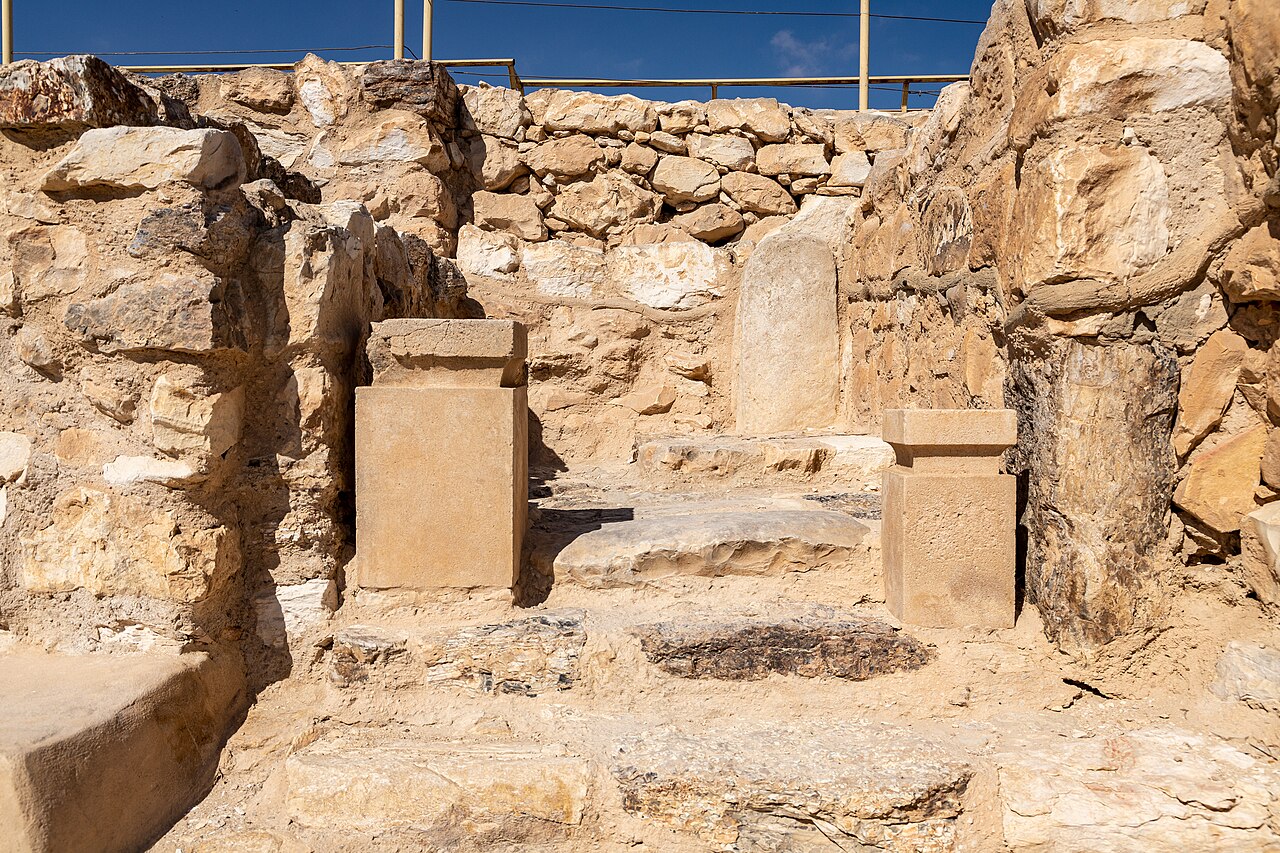
Era 4 · Covenant and WildernessLeviticus
Altars of Ancient Israel
Arad, Beersheba, and the temple at Tel Motza
Leviticus 6–7 repeats the offerings, this time as instructions for the priests. "The fire shall ever be burning upon the altar; it shall never go out." Every morning the priest, dressed in linen, removes the ashes and adds wood.
The priests eat the grain offering in the courtyard, unleavened, "in the holy place." The purification offering is most holy: anything that touches its flesh becomes holy; a clay pot used to boil it must be broken. The priest who offers the burnt offering keeps its skin. The breast is waved before the LORD and given to Aaron and his sons, the right thigh to the officiating priest.
"This is the law of the burnt offering, of the meat offering, and of the sin offering, and of the trespass offering, and of the consecrations, and of the sacrifice of the peace offerings; Which the LORD commanded Moses in mount Sinai."
The shrine at Arad
Tel Arad, in the eastern Negev, was a royal Judahite fortress. Inside, Yohanan Aharoni's excavations in the 1960s found a sanctuary: a courtyard with a large altar of earth and unhewn stones (about 2.5 m square, matching the tabernacle's altar of five by five cubits), a hall, and a small raised niche, the "holy of holies," with two limestone incense altars on its steps and one or two standing stones (masseboth). Ostraca from the fortress mention "the house of YHWH" and priestly families known from the Bible, Pashhur and Meremoth, and the sons of Korah.
In 2020 Eran Arie, Baruch Rosen and Dvory Namdar analyzed the dark residue on the two incense altars. The smaller altar held frankincense mixed with animal fat; the larger held cannabis mixed with dung to keep it burning slowly. It is the earliest known evidence of cannabis in a ritual in the ancient Near East. The shrine dates to the mid-8th century BC and was apparently covered over within a few decades, perhaps in Hezekiah's or Josiah's reforms.
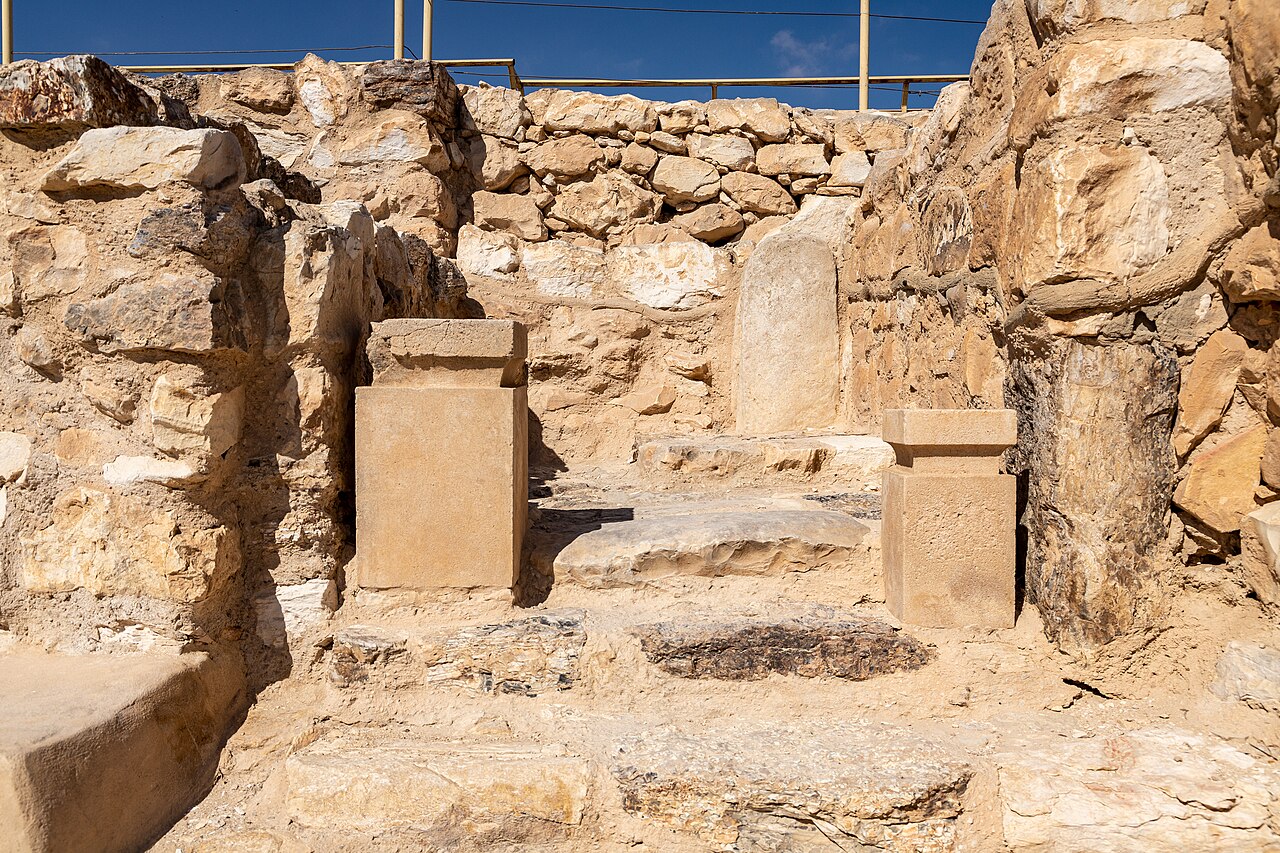
Arad shows Judahites worshiping the LORD with an altar of the right size and shape, incense, and priestly families. It also shows what the Bible's reformers condemned: a temple outside Jerusalem, standing stones, and a psychoactive incense the Torah never mentions.
The temple at Tel Motza
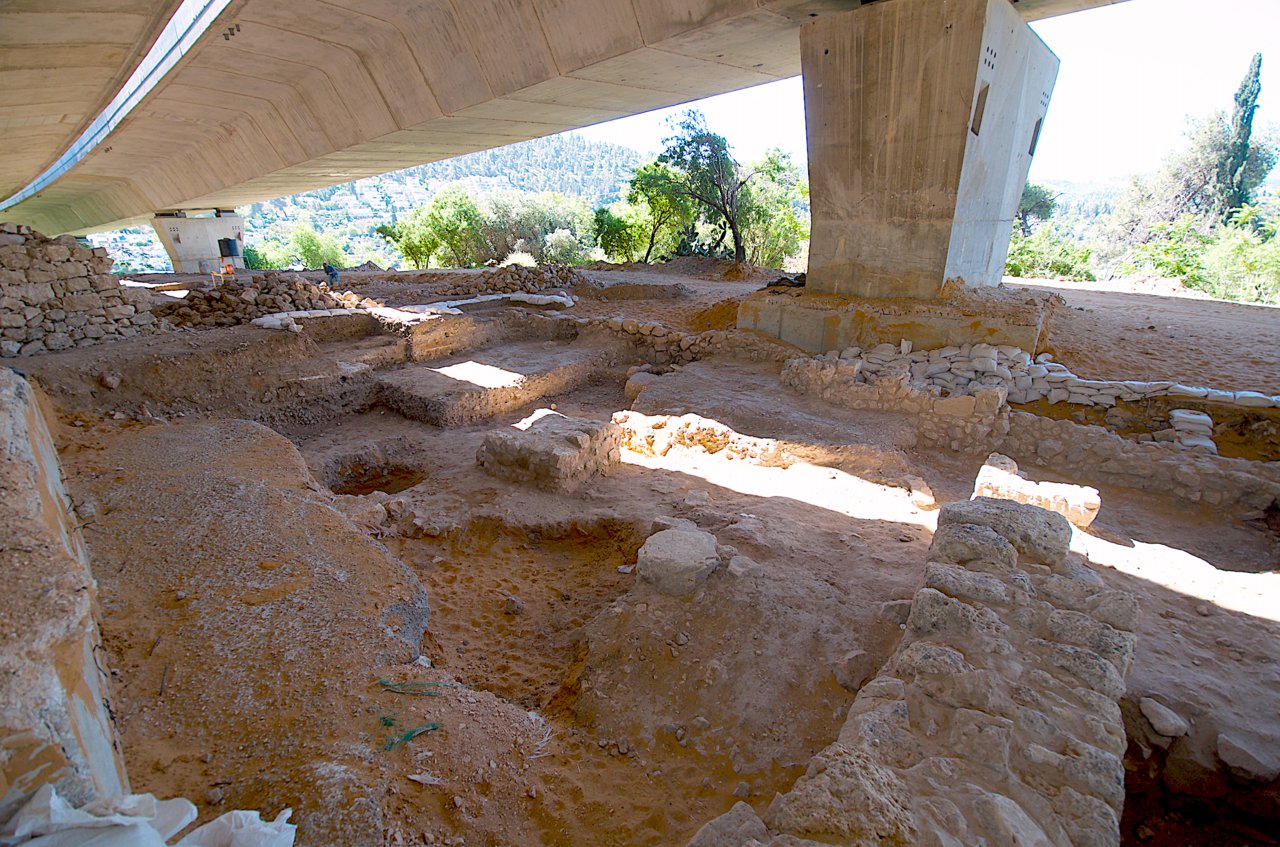
Excavations in 2012 and later at Tel Motza, about 7 km west of Jerusalem, uncovered a monumental temple built in the early 9th century BC (some date it to the late 10th). Like Solomon's Temple as described in 1 Kings 6, it faced east, with a courtyard and an altar before it. In a pit (favissa) the excavators found ritual vessels, chalices, and figurines of horses and of human heads. It was in use for over two centuries, close to the Jerusalem Temple, during the monarchy.
The horned altar of Beersheba
Described in the previous lesson: a large horned altar of cut stones, dismantled and reused in a storehouse wall in the late 8th century BC. Smaller four-horned limestone altars, for incense, have been found at Megiddo, Dan, Ekron and many other sites.
The Case for the Biblical Account
Scripture's account
Instructions for the priests on the continual fire, the handling of offerings, and the priests' portions (Leviticus 6:8–7:38).
What evidence would we expect?
Israelite sanctuaries with sacrificial and incense altars; priests named in records; animal remains and ash from offerings.
The discoveries
The Arad shrine (altar of five by five cubits, incense altars with frankincense and cannabis residue, priestly names in ostraca); the Tel Motza temple; the Beersheba horned altar; many incense altars.
Testing the discoveries
All are from the monarchy (10th–7th centuries BC). They confirm real Yahwistic worship with altars and incense, and also local temples and practices that Deuteronomy and Kings condemn.
The strongest reconstruction
The sacrificial worship Leviticus describes was practiced in Israel and Judah, at more places and in more varied ways than the Torah allows.
What remains possible
That Leviticus preserves an ancient ideal often not followed; or that its written form reflects the centralized worship of a later time.
One sanctuary or many?
Leviticus and Deuteronomy describe one legitimate sanctuary. Kings repeatedly reports that the people "sacrificed and burnt incense in the high places" anyway. Arad and Motza are what that looked like. On this view archaeology confirms the Bible's own account of a gap between law and practice.
Many scholars think centralization was a late monarchic innovation (Hezekiah, Josiah, Deuteronomy), and that the earlier temples at Arad and Motza were considered legitimate in their day. Leviticus' single tabernacle would then reflect a later idea.
What the evidence shows
- The Arad shrine's altar measured about five by five cubits.Source: Y. Aharoni, "Arad: Its Inscriptions and Temple," Biblical Archaeologist 31 (1968); Z. Herzog, "The Arad Fortresses" (2002)
- Residue on the Arad incense altars contained frankincense and cannabis.Source: E. Arie, B. Rosen and D. Namdar, "Cannabis and Frankincense at the Judahite Shrine of Arad," Tel Aviv 47:1 (2020) ↗
- Arad ostraca mention "the house of YHWH" and priestly families named in the Bible.Source: Y. Aharoni, Arad Inscriptions (1981): ostraca 18 ("the house of YHWH") and 49
- A Judahite temple operated at Tel Motza near Jerusalem from the 9th century BC.Source: S. Kisilevitz and O. Lipschits, "Another Temple in Judah! The Tale of Tel Moẓa," BAR 46:1 (2020); Kisilevitz, "The Iron IIA Judahite Temple at Tel Moza," Tel Aviv 42 (2015)
- The Arad shrine was dismantled in a royal religious reform. The date and cause are debated.
Continue the journey
Connected elsewhere in ScriptureHezekiah and Sennacherib2 Kings 18:4: Hezekiah "removed the high places, and brake the images."More from this lesson
Why this matters to the rest of Scripture
- Hezekiah "removed the high places, and brake the images."
- Josiah defiles the high places "from Geba to Beersheba."
- Offer "in the place which the LORD shall choose."
- The altar five cubits by five.
- "In every place incense shall be offered unto my name."