Era 4 · Covenant and WildernessLeviticus
Holy Priests, Unblemished Offerings
"They shall be holy unto their God"
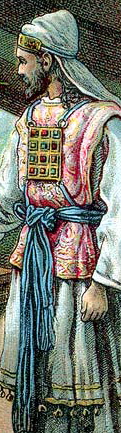
A priest may not make himself unclean for the dead, "but for his kin, that is near unto him": his mother, father, son, daughter, brother, and unmarried sister. He must not shave his head or cut his flesh in mourning. The high priest may not even mourn his parents in that way, "for the crown of the anointing oil of his God is upon him."
A descendant of Aaron with a physical defect (blindness, lameness, a broken limb, and others listed) may not approach the altar to offer the bread of his God. "He shall eat the bread of his God, both of the most holy, and of the holy." He remains a priest and is fed from the offerings.
Offerings must be "perfect to be accepted; there shall be no blemish therein": no blind, injured or diseased animal. An animal must stay with its mother seven days, and a mother and her young are not to be killed on the same day.
Priests and the dead
Death was the strongest source of impurity in Israel. Neighboring religions honored the dead and the ancestors in cult; Israel's priests were kept apart from the dead to stay with the God of the living. The ban on cutting the flesh and shaving in mourning (21:5; 19:28) rejected practices known among Israel's neighbors: at Ugarit the god El himself gashes his skin in grief for Baal.
What the disability rules do and do not say
A priest with a defect could not perform the altar service, but he still ate the holiest food and kept his priestly status. The rule concerned the visible "wholeness" of the altar service, as with the animals, not his worth or holiness. Elsewhere Leviticus protects the disabled (19:14), and later prophets picture the lame and blind gathered into God's people (Jeremiah 31:8; Micah 4:6–7). Readers today may still find the rule troubling, and Jewish and Christian interpreters have reflected on it.
Mother and young
The rules that a newborn animal stay with its mother seven days and that a mother and her young are not killed on the same day (22:27–28) belong with Deuteronomy 22:6–7 (letting the mother bird go) and the command not to boil a kid in its mother's milk. Jewish tradition read them as teaching compassion.
The Case for the Biblical Account
Scripture's account
Higher standards of purity for priests and requirements for unblemished offerings (Leviticus 21–22).
What evidence would we expect?
Ancient rules for the bodily fitness of priests and offerings; mourning practices that Israel rejected.
The discoveries
Mesopotamian requirements that diviners and priests be physically unblemished; Hittite rules on the purity of offerings; Ugaritic descriptions of self-laceration in mourning.
Testing the discoveries
These show the rules belonged to a wider ancient understanding of the sacred.
The strongest reconstruction
Leviticus 21–22 apply ancient standards of sacred fitness to Israel's priests, within a framework that also protects priests and animals.
What remains possible
How strictly the rules were applied in different periods.
What the evidence shows
- Mesopotamian diviners were required to be free of physical defects. W. G. Lambert, "The Qualifications of Babylonian Diviners" (1998).
- Ugaritic myth describes El cutting his skin in mourning.
- Priests with defects kept their status and their share of holy food. Leviticus 21:22.
- "I the LORD do sanctify them."
Continue the journey
Connected elsewhere in ScriptureAaron's Staff and the TithesNumbers 18: The duties and support of priests and Levites.More from this lesson
Why this matters to the rest of Scripture
- The duties and support of priests and Levites.
- Blind and lame offerings condemned.
- Ezekiel's rules for priests.
- "A lamb without blemish and without spot."
- "Holy, harmless, undefiled, separate from sinners."
- "Call the poor, the maimed, the lame, the blind."