Era 4 · Covenant and WildernessLeviticus
The Sabbath and the Spring Feasts
"These are the feasts of the LORD"
"Concerning the feasts of the LORD, which ye shall proclaim to be holy convocations… Six days shall work be done: but the seventh day is the sabbath of rest… it is the sabbath of the LORD in all your dwellings."
"In the fourteenth day of the first month at even is the LORD's passover. And on the fifteenth day of the same month is the feast of unleavened bread… seven days."
When Israel reaps its first harvest in the land, they bring "a sheaf of the firstfruits" of barley to the priest, who waves it before the LORD "on the morrow after the sabbath." No one may eat bread or roasted grain from the new crop until then.
From that day they count seven full weeks, fifty days, and bring a new grain offering: two loaves of wheat, baked with leaven, the Feast of Weeks. "And when ye reap the harvest of your land… thou shalt leave them unto the poor, and to the stranger: I am the LORD your God."
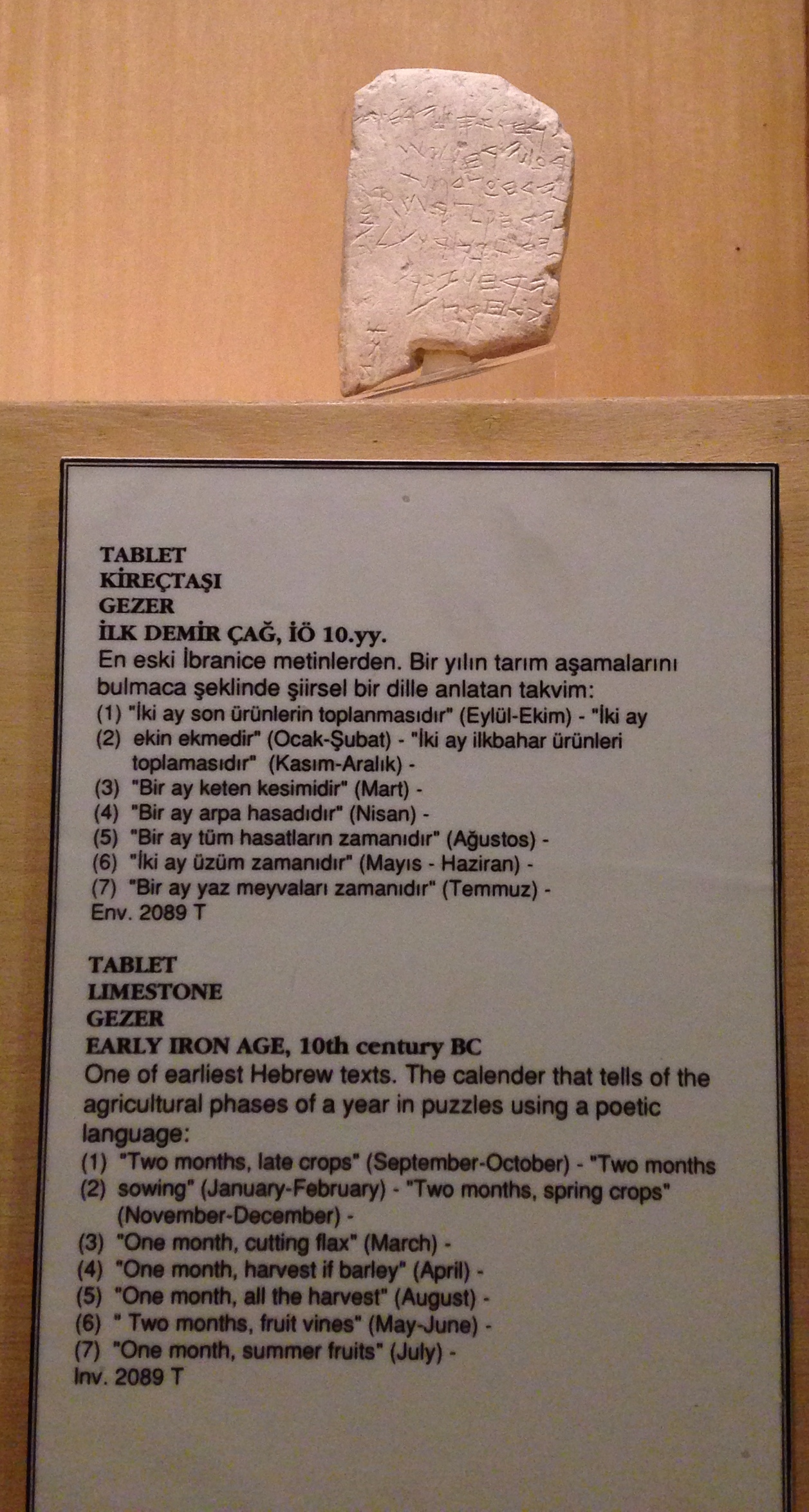
The Gezer Calendar
Found at Gezer in 1908, this small limestone tablet from the 10th century BC is one of the oldest Hebrew (or Canaanite) inscriptions. It lists the farming year in months: two months of ingathering (olives), two of sowing, two of late sowing, a month of hoeing flax, a month of barley harvest, a month of harvest and measuring (wheat), two months of vine tending, and a month of summer fruit. It is the agricultural year behind Leviticus 23: barley first, then wheat seven weeks later, then the fall harvest.
Festival calendars at Emar
At Emar, a Late Bronze Age city on the Euphrates in Syria (14th–12th centuries BC), archaeologists found the ritual archive of a local diviner, including calendars of festivals tied to the months and harvests, some lasting seven days, some beginning on the full moon of the first month. Daniel Fleming has shown how closely the structure of these West Semitic calendars resembles Leviticus 23, much earlier than once supposed possible.
"The morrow after the sabbath"
Which Sabbath? The Pharisees said the day after the first day of Passover (a festival rest), so Weeks always fell on the same date. The Sadducees and later the Karaites said the day after the weekly Sabbath, so Weeks always fell on a Sunday. The Book of Jubilees and Qumran had a third view. The dispute shows how carefully Second Temple Jews read Leviticus.
The Case for the Biblical Account
Scripture's account
The weekly Sabbath and the spring festivals: Passover, Unleavened Bread, the first sheaf, and the Feast of Weeks (Leviticus 23:1–22).
What evidence would we expect?
Agricultural calendars matching the festivals; ancient festival calendars in the region; early evidence of these festivals' observance.
The discoveries
The Gezer Calendar (10th century BC); the Emar ritual calendars (13th century BC); the Elephantine Passover letter (419 BC); Second Temple calendar disputes.
Testing the discoveries
The calendars show the festivals' agricultural basis and an ancient West Semitic pattern. They do not show that Israel's specific festivals were established at Sinai.
The strongest reconstruction
Leviticus 23 fits the agricultural year of Canaan and an old regional tradition of festival calendars, given new meaning by Israel's history.
What remains possible
How the various biblical festival calendars (Exodus 23 and 34, Leviticus 23, Numbers 28–29, Deuteronomy 16) relate to each other in date and purpose.
| Festival | Exodus 23 / 34 | Leviticus 23 | Deuteronomy 16 |
|---|---|---|---|
| Sabbath | Yes | Yes (listed first) | No (in 5:12–15) |
| Passover | Ex 34:25 only | 14th of the first month | At the chosen place |
| Unleavened Bread | Seven days | 15th–21st | Seven days |
| First sheaf | No | Yes | No |
| Weeks / Harvest | Yes | Fifty days after the sheaf | Seven weeks |
| Trumpets | No | 1st of the seventh month | No |
| Day of Atonement | No | 10th of the seventh month | No |
| Booths / Ingathering | Yes | 15th, seven days plus an eighth | Seven days |
Then and Later
The Feast of Weeks, then and later
- SinaiLeviticus 23:15–21. Count fifty days and bring new bread.
- 2nd c. BCJubilees. The Book of Jubilees links the feast with covenant renewal.The Dead Sea Scrolls →
- c. AD 30Pentecost. On the Feast of Weeks (Greek Pentecost, "fiftieth"), the Spirit comes on the disciples in Jerusalem.
- RabbinicShavuot. Celebrated as the anniversary of the giving of the Torah at Sinai; the book of Ruth is read.
- TodayTwo festivals. Jews keep Shavuot; Christians keep Pentecost, seven weeks after Easter.
What the evidence shows
- The Gezer Calendar (10th century BC) lists barley harvest before wheat harvest.Source: The Gezer Calendar, 10th century BC, Istanbul Archaeology Museums; S. Talmon, "The Gezer Calendar and the Seasonal Cycle," JAOS 83 (1963)
- Late Bronze Age Emar had festival calendars structured like Leviticus 23.Source: D. E. Fleming, "The Israelite Festival Calendar and Emar's Ritual Archive," Revue Biblique 106 (1999); Time at Emar (2000)
- Pharisees and Sadducees disputed the date of the first sheaf. Mishnah Menahot 10:3; Babylonian Talmud Menahot 65a.
- "These are the feasts of the LORD."
Continue the journey
Echoes Across CivilizationsSacred calendarsDid Israel's neighbors have calendars of yearly festivals like Leviticus 23?More from this lesson
Echoes Across Civilizations
Optional: how other ancient peoples told similar stories. Open one to compare, then come back to the lesson.
Sacred calendarsEmar · Israelite or Canaanite · Babylonian
Did Israel's neighbors have calendars of yearly festivals like Leviticus 23?
- Emar: The ritual archive of Emar (Emar 446 and related texts) Shared literary world
- Israelite or Canaanite: The Gezer Calendar Shared literary world
- Babylonian: The Akitu (New Year) festival Possible historical contact
Why this matters to the rest of Scripture
- The offerings for every day, Sabbath, new moon and festival.
- The first Passover.
- The festivals at the chosen place.
- "Christ… the firstfruits of them that slept."
- "When the day of Pentecost was fully come."
- "The sabbath was made for man."