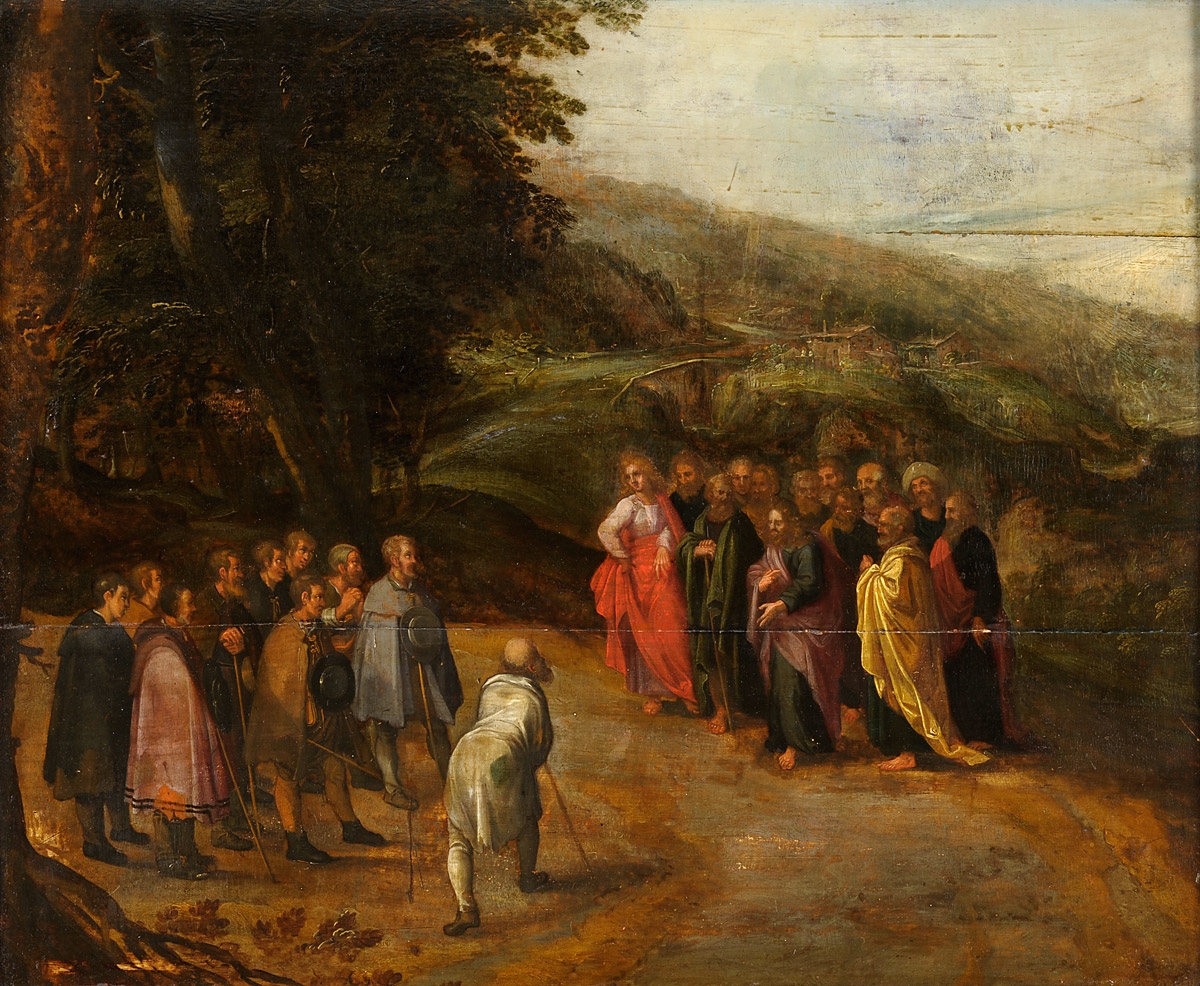
"When a man shall have in the skin of his flesh a rising, a scab, or bright spot… then he shall be brought unto Aaron the priest." The priest looks at whether the hair has turned white and whether the spot is deeper than the skin. He may shut the person away for seven days and look again.
Someone declared unclean "shall rend his clothes… and shall cry, Unclean, unclean… he shall dwell alone; without the camp shall his habitation be." Garments of wool, linen or leather with a greenish or reddish spot are examined too, and burned if it spreads.
When the person recovers, the priest goes out to them. Two clean birds are taken: one is killed over fresh water in a clay pot; the other, dipped with cedar wood, scarlet yarn and hyssop in the blood, is released alive "into the open field." The person washes, shaves, and after seven days brings offerings. Blood and oil are put on the right ear, thumb and toe, as at the priests' ordination.
When Israel reaches Canaan, even a house may have it: "hollow strakes, greenish or reddish." The stones are removed and replaced; if it returns, the house is torn down.
Not Hansen's disease
Leprosy (Hansen's disease) attacks nerves, causing numbness and, over years, deformity. The symptoms in Leviticus 13 are different: white patches, scaly or raw skin, conditions that can heal in a week or two. Doctors who have studied the chapter suggest psoriasis, vitiligo, fungal infections, eczema and similar conditions. The Hebrew word also covers mold on cloth and walls, which no human disease does.
How did "leprosy" enter our Bibles? The Greek Septuagint translated tzara'at as lepra, a Greek word for scaly skin conditions (from lepis, a scale). Only later did lepra come to mean the disease we call leprosy. The Latin Vulgate kept lepra, and English translations followed. Many modern translations now say "skin disease" or "defiling disease."
When did leprosy reach the Holy Land?
The oldest skeletal evidence of Hansen's disease comes from India around 2000 BC. In 2009 DNA analysis of a man buried in a shroud in a 1st-century AD tomb at Akeldama, Jerusalem, found Mycobacterium leprae, the earliest confirmed case in the region. By Jesus' time, true leprosy existed in Judea alongside the older category.
Mold in the walls
The house law reads like an ancient building inspection: look for greenish or reddish depressions, remove the stones, scrape the plaster, and demolish if it spreads. Interpreters compare it with mold, dry rot or saltpeter efflorescence. The text treats it as a ritual uncleanness that also happens to protect the household.
The Case for the Biblical Account
Scripture's account
Priests diagnose and declare tzara'at in people, garments and houses; restored persons are purified (Leviticus 13–14).
What evidence would we expect?
Ancient terms and practices for skin conditions and quarantine; evidence of leprosy and other diseases in the region; continued practice of the purification rite.
The discoveries
Mesopotamian texts treating skin disease (saḫaršubbû) as divine punishment and exclusion from the city; the Septuagint's lepra; the Akeldama tomb with M. leprae DNA (1st century AD); Gospel accounts of lepers sent to the priests.
Testing the discoveries
The terminology is well understood. Hansen's disease is present in the region by the 1st century AD, but tzara'at is a broader category.
The strongest reconstruction
Tzara'at was a ritual category of visible, spreading surface conditions, not a single disease, managed by priests rather than doctors.
What remains possible
Which modern conditions correspond to each description remains debated.
What the evidence shows
- Tzara'at in Leviticus is not the same as Hansen's disease.Source: On tzara'at and "leprosy": E. V. Hulse, "The Nature of Biblical 'Leprosy'," Palestine Exploration Quarterly 107 (1975); Milgrom, Leviticus 1–16, pp. 816–826
- The Septuagint's lepra originally meant a scaly skin condition.
- M. leprae DNA was found in a 1st-century AD Jerusalem burial.Source: C. L. Matheson et al., "Molecular Exploration of the First-Century Tomb of the Shroud in Akeldama, Jerusalem," PLoS ONE 4(12): e8319 (2009) ↗
- The house law describes mold or similar growths.
Continue the journey
Connected elsewhere in ScriptureMiriam and Aaron Against MosesNumbers 12:10–15: Miriam struck with tzara'at and shut out seven days.More from this lesson
Why this matters to the rest of Scripture
- Miriam struck with tzara'at and shut out seven days.
- Naaman washes seven times in the Jordan.
- King Uzziah dwells in a separate house.
- Jesus touches a leper: "go thy way, shew thyself to the priest."
- Ten lepers healed; one returns to give thanks.