Era 4 · Covenant and WildernessLeviticus
Purification and Reparation
"He shall restore it in the principal, and shall add the fifth part more"
"If a soul shall sin through ignorance against any of the commandments of the LORD…" Leviticus 4 deals with unintentional sins, and it starts at the top. If the anointed priest sins, he brings a bull, and its blood is sprinkled seven times before the veil and put on the horns of the incense altar inside the holy place. The same for the whole congregation.
If a ruler sins, he brings a male goat, and the blood goes on the horns of the outer altar. An ordinary person brings a female goat or lamb. The poor bring two birds; the very poor, a tenth of an ephah of flour. "And the priest shall make an atonement for him… and it shall be forgiven him."
Some wrongs need more than an offering. If someone lies to a neighbor about something left in his care, robs him, cheats him, or finds lost property and swears falsely about it, "he shall restore that which he took violently away… he shall even restore it in the principal, and shall add the fifth part more thereto, and give it unto him to whom it appertaineth." Only then does he bring a ram as a guilt offering to the LORD.
Horned altars
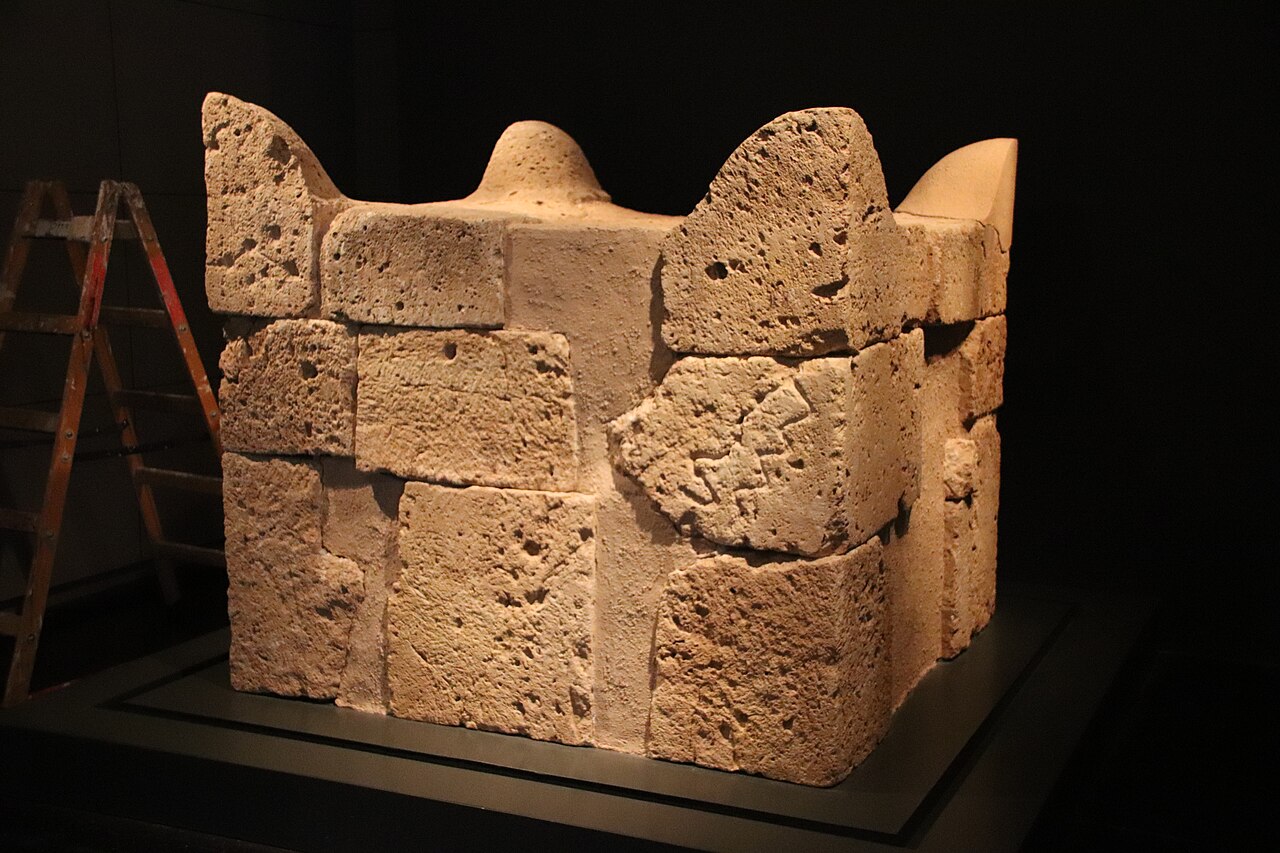
The blood of the purification offering was put "upon the horns of the altar." In 1973 Yohanan Aharoni's team at Tel Beersheba found large dressed stones reused in the walls of a storehouse, including three corner stones carved with horns. Reassembled, they formed a four-horned altar about 1.6 m high, of carefully cut sandstone; one stone bears a carved snake. The altar had apparently been dismantled in the late 8th century BC, perhaps during King Hezekiah's reform, when "he removed the high places" (2 Kings 18:4).
The Beersheba altar is made of cut stone, which Exodus 20:25 forbids for an altar ("if thou lift up thy tool upon it, thou hast polluted it"). It shows the horned form described in the Torah, and also that real worship in Judah did not always follow its rules.
Clinging to the horns
The horns were the holiest part of the altar. Adonijah and Joab fled to the tabernacle and "caught hold on the horns of the altar" for sanctuary (1 Kings 1:50; 2:28). Amos warned that "the horns of the altar shall be cut off" at Bethel (Amos 3:14).
"Sin offering" or "purification offering"?
The Hebrew chatta't comes from the verb for sin, and traditional translations say "sin offering." But the same offering is required after childbirth (12:6), after recovery from skin disease, and to purify the altar itself (8:15), none of them sins. Jacob Milgrom argued that "purification offering" is the better translation: its blood cleanses the sanctuary from the pollution that sin and impurity cause. Many modern translations now note this.
The Case for the Biblical Account
Scripture's account
Purification offerings graded by status and means; reparation offerings requiring restitution plus one fifth (Leviticus 4:1–6:7).
What evidence would we expect?
Horned altars; ancient laws requiring restitution with a penalty; sliding scales for the poor.
The discoveries
Horned altars at Beersheba, Megiddo, Dan, Arad and elsewhere; ancient Near Eastern laws on deposits, false oaths and restitution (Hammurabi §§ 120–126; Exodus 22:7–13).
Testing the discoveries
The altars are real and date to the monarchy. They match the form, not necessarily the rules.
The strongest reconstruction
Leviticus' system for unintentional sin and fraud fits ancient legal and cultic practice, with a distinctive insistence on restoring the neighbor first.
What remains possible
How these rules were practiced in different periods remains open; the prophets complain that they often were not.
What about deliberate sins?
Leviticus 4 covers sins "through ignorance." Numbers 15:30–31 says that whoever sins "presumptuously" (with a high hand) has no offering. Yet Leviticus 6:1–7 allows a guilt offering for deliberate fraud and false oaths once the offender confesses and repays. Jewish interpretation concluded that repentance and confession change the status of a deliberate sin; this became the foundation of the rabbinic teaching on teshuvah (repentance).
What the evidence shows
- A four-horned altar of cut stone was found dismantled at Tel Beersheba.Source: Y. Aharoni, "The Horned Altar of Beer-sheba," Biblical Archaeologist 37 (1974); Z. Herzog, Beer-Sheba III (2016)
- The Beersheba altar was dismantled during Hezekiah's reform.Source: Y. Aharoni, "The Horned Altar of Beer-sheba," Biblical Archaeologist 37 (1974); Z. Herzog, Beer-Sheba III (2016)
- "Purification offering" is a more accurate translation of chatta't. Widely accepted; some scholars keep "sin offering" in moral contexts (Gane).Source: J. Milgrom, "Sin-Offering or Purification-Offering?" Vetus Testamentum 21 (1971)
- "It shall be forgiven him."
Continue the journey
Connected elsewhere in ScripturePurification, Vows, and the Written BlessingNumbers 5:5–8: Confession and restitution plus a fifth.More from this lesson
Why this matters to the rest of Scripture
- Confession and restitution plus a fifth.
- Zacchaeus: "if I have taken any thing… I restore him fourfold."
- "First be reconciled to thy brother, and then come and offer thy gift."
- "He hath made him to be sin for us."
- Adonijah holds the horns of the altar.
- "When thou shalt make his soul an offering for sin (asham)."