Era 4 · Covenant and WildernessLeviticus
Redeeming the Poor
"If thy brother be waxen poor… thou shalt relieve him"
"And if thy brother be waxen poor, and fallen in decay with thee; then thou shalt relieve him: yea, though he be a stranger, or a sojourner; that he may live with thee. Take thou no usury of him, or increase: but fear thy God."
If he sells himself to you, "thou shalt not compel him to serve as a bondservant: But as an hired servant… he shall be with thee… unto the year of jubile." "For they are my servants, which I brought forth out of the land of Egypt: they shall not be sold as bondmen. Thou shalt not rule over him with rigour."
Slaves may be bought from the nations around and from foreign residents, "and they shall be your bondmen for ever."
If an Israelite sells himself to a wealthy foreigner, "one of his brethren may redeem him: Either his uncle, or his uncle's son… or any that is nigh of kin unto him." The price is reckoned by the years left to the Jubilee.
The kinsman-redeemer
The go'el redeems land (25:25), a relative sold into slavery (25:48), and, in other laws, avenges a killed relative (Numbers 35). In Ruth, Boaz acts as go'el, buying Naomi's land and marrying Ruth (Ruth 4). Jeremiah buys his cousin's field at Anathoth as go'el, with a sealed deed, even as Babylon besieges Jerusalem (Jeremiah 32). Isaiah calls God Himself Israel's Redeemer (Go'el) more than a dozen times.
Clay seals and land deeds
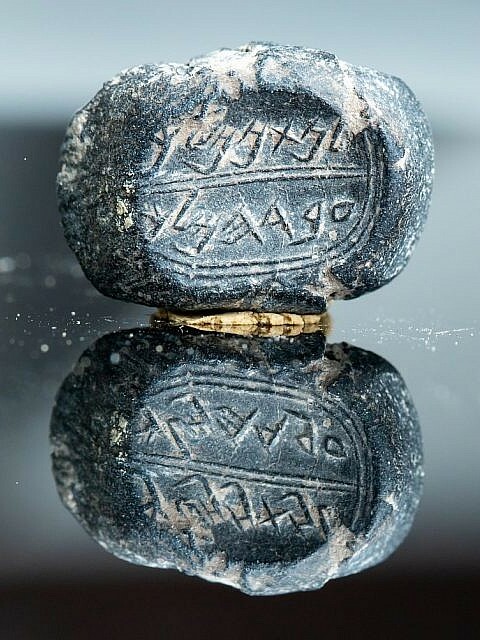
Jeremiah 32 describes a deed written in two copies, one sealed and one open, stored in a clay jar. Hundreds of clay bullae (seal impressions) from Judah in the 7th–6th centuries BC, many with Hebrew names and string marks from rolled documents, show exactly this practice of sealed papyrus deeds.
The hard contrast
Leviticus 25 forbids permanent slavery for Israelites but permits it for foreigners (25:44–46). This is not hidden. Interpreters have read it as a concession to the ancient economy, as a boundary marking Israel's special redemption, or as a real moral limit of the law that later revelation moved beyond. Jewish law later restricted it; Christian abolitionists pointed to the Exodus and to the Liberty Bell's verse from this same chapter. The tension is part of the history.
The Case for the Biblical Account
Scripture's account
Help without interest for the poor; Israelite debt-servants freed at the Jubilee and redeemable by kin; permanent foreign slaves (Leviticus 25:35–55).
What evidence would we expect?
Ancient laws on interest, debt-slavery and redemption by relatives; documents of land redemption.
The discoveries
Hammurabi § 117 (debt-slaves freed after three years); Old Babylonian and Nuzi redemption by relatives; Jeremiah 32's deed and the bullae of Judah; Elephantine loan contracts with interest.
Testing the discoveries
Debt-slavery and redemption were widespread; interest-free lending to the poor is distinctive to Israel's law.
The strongest reconstruction
Leviticus 25 limits the debt-slavery of its world for Israelites and creates a duty of family redemption, while leaving foreign slavery in place.
What remains possible
How fully these protections were practiced; the prophets (Amos 2:6) suggest they were often ignored.
What the evidence shows
- Hammurabi's law freed family members sold for debt after three years.Source: Laws of Hammurabi § 117; M. T. Roth, Law Collections (1997)
- Judahite clay bullae show sealed papyrus documents in the late monarchy.
- Leviticus 25 permits permanent slavery of foreigners.
- "They are my servants, which I brought forth out of the land of Egypt."
Continue the journey
Ancient MysteriesRedeemer or Brother-in-Law? The Law Behind Ruth 3–4Was Boaz obliged to marry Ruth, and how does Ruth 4 relate to Leviticus 25 and Deuteronomy 25?More from this lesson
Investigations
Optional deep dives: the ancient sources, the physical evidence, and every interpretation side by side, including unconventional ones, each labeled for what it is.
Redeemer or Brother-in-Law? The Law Behind Ruth 3–4Laws: documented · How they combine in Ruth: disputed
Was Boaz obliged to marry Ruth, and how does Ruth 4 relate to Leviticus 25 and Deuteronomy 25?
Boaz is a go'el, a kinsman-redeemer: a relative with a duty to buy back family land (Leviticus 25:25). Deuteronomy 25 defines a different duty, levirate marriage, for the dead man's brother. Boaz is not Mahlon's brother, yet Ruth 4 joins land redemption with marriage "to raise up the name of the dead." The sandal ceremony is also different from Deuteronomy's.
Open the full investigation →Echoes Across Civilizations
Optional: how other ancient peoples told similar stories. Open one to compare, then come back to the lesson.
Debt release and libertySumerian · Babylonian · Assyrian and Nuzi
Did other ancient peoples cancel debts and free debt-slaves, like the Jubilee?
- Sumerian: Reforms of Uruinimgina (Urukagina) Shared literary world
- Babylonian: The Edict of Ammi-saduqa (a misharum decree) Possible historical contact
- Assyrian and Nuzi: Andurarum proclamations Possible historical contact
Why this matters to the rest of Scripture
- Boaz redeems.
- Jeremiah buys his cousin's field.
- "Thus saith the LORD, your redeemer."
- "They sold… the poor for a pair of shoes."
- "To redeem them that were under the law."
- "Redeemed… with the precious blood of Christ."