Era 4 · Covenant and WildernessLeviticus
How Leviticus Came to Us
Authorship, ancient scrolls, translations, and what changed along the way
Leviticus presents itself almost entirely as God's speech to Moses: "And the LORD spake unto Moses, saying…" opens chapter after chapter, and it ends, "These are the commandments, which the LORD commanded Moses… in mount Sinai." Jewish and Christian tradition received it as the third book of Moses.
Unlike Exodus, Leviticus never says Moses wrote anything down. Its claim is that the instruction came from God through Moses. Many modern scholars see it as the work of priestly writers over generations, who preserved and shaped Israel's sacred law. Many believers hold that Moses received the foundational law and that faithful priests and scribes transmitted and arranged it.
What we can examine directly is how Leviticus was copied. Thanks to the Dead Sea Scrolls, we have copies of Leviticus from more than a thousand years before the oldest complete Hebrew Bibles, in three languages and two Hebrew scripts. They show a text copied with remarkable care.
The Leviticus Scroll from Cave 11
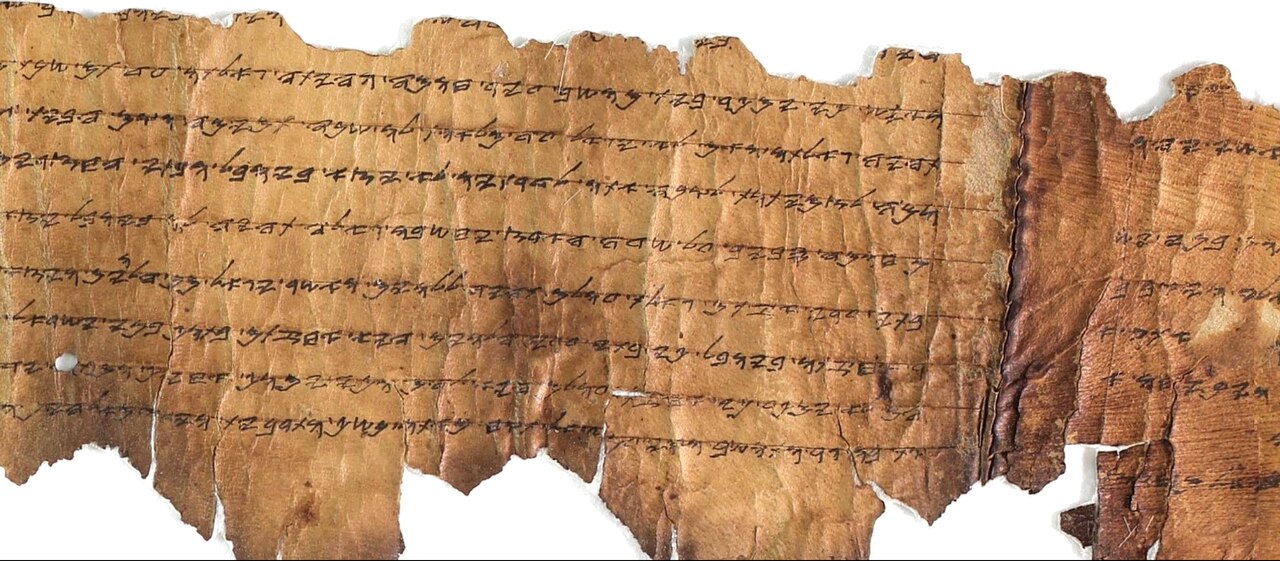
Found in 1956 in Qumran Cave 11, 11QpaleoLev-a is one of the most impressive biblical scrolls: a long, tightly rolled scroll written in the old paleo-Hebrew script, copied around 100–50 BC. Unrolled in the 1960s, it preserves parts of Leviticus 4 and 10–27. Like other paleo-Hebrew scrolls, it shows that some scribes deliberately used Israel's ancient script for the books of Moses long after the square script had become standard.
How many Leviticus manuscripts?
It depends on how you count. Sarianna Metso listed seventeen manuscripts from the Judean Desert: in Hebrew (square and paleo-Hebrew scripts), in Greek, and one in Aramaic. Later studies, as more fragments were identified and published, count more than twenty; Innocent Himbaza's survey discusses twenty-seven manuscripts and fragments, including copies from Masada. Numbers change as fragments are joined, separated or newly identified.
Greek Leviticus at Qumran
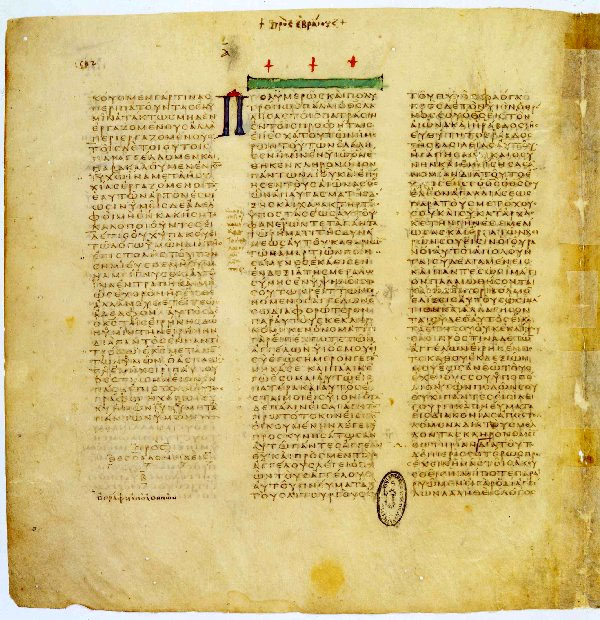
Two Greek copies of Leviticus were found in Qumran Cave 4: a leather scroll (4QLXXLev-a) and a papyrus (pap4QLXXLev-b), both from the 1st century BC, among the oldest Septuagint manuscripts in existence. The papyrus writes God's name as ΙΑΩ (Iao), a Greek spelling of the divine name, rather than kyrios, "Lord," which became standard in later Christian copies.
An Aramaic Leviticus
A small Aramaic translation of Leviticus 16, the Day of Atonement (4Q156, 4QtgLev), was also found in Cave 4: one of the earliest examples of a Targum, the Aramaic paraphrases read in synagogues.
The scroll from En-Gedi
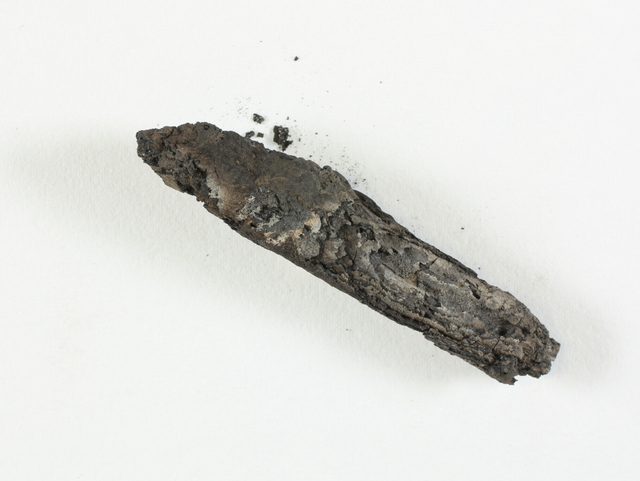
In 1970 archaeologists excavating a synagogue at En-Gedi, near the Dead Sea, found a scroll so badly burned it was a lump of charcoal. In 2015 a team led by computer scientist Brent Seales used high-resolution micro-CT scanning and "virtual unwrapping" to read it without opening it: Leviticus 1:1–2:11, which its editors report agrees with the consonants of the Masoretic Text in the verses that survive. Dated by its script to the 3rd–4th century AD (some argue as early as the 1st–2nd), it is the oldest Pentateuch scroll found since the Dead Sea Scrolls.
Traditions, manuscripts and translations
| Witness | What it is | Why it matters for Leviticus |
|---|---|---|
| Masoretic Text | A Hebrew textual tradition, standardized in the Middle Ages (Leningrad Codex, 1008) | The basis of most modern translations. In the passages that survive, the En-Gedi scroll (Leviticus 1–2) and the Masada fragments (parts of Leviticus 4 and 8–11) agree closely with it in their consonants; that is strong continuity for those passages, not proof that every ancient copy was identical |
| Septuagint | A translation tradition, made in the 3rd century BC, with many manuscripts of its own | Oldest copies found at Qumran; sometimes agrees with the Samaritan and Qumran texts against the Masoretic (17:4) |
| Samaritan Pentateuch | A Hebrew textual tradition, the Torah of the Samaritan community | A separate line of copying from shared earlier ancestors; a few harmonizing expansions |
| Judean Desert manuscripts | Surviving manuscripts, not one tradition: Qumran, Masada and Nahal Hever copies, 2nd c. BC – 2nd c. AD | A thousand years older than the medieval codices; show both continuity and variants |
Where the copies and translations differ
| Passage | What differs | Kind of difference |
|---|---|---|
| Leviticus 17:4 | A longer text in the Samaritan, Septuagint and 4QLev-d | Manuscript variant; see the passage page |
| Leviticus 16:8 | "For Azazel" or "for the scapegoat" / "the one sent away" | Translation and interpretation; see the passage page |
| Leviticus 4–6 | "Sin offering" or "purification offering" (chatta't) | Translation choice |
| Leviticus 13–14 | "Leprosy" or "skin disease" (tzara'at) | Translation choice |
| Leviticus 11 | Identities of some forbidden birds and animals | Uncertain vocabulary; ancient translations disagree |
| Throughout | Small differences in spelling and wording among the Qumran copies, the Samaritan text and the Masoretic Text | Minor variants |
Composition: how scholars have explained it
The laws were revealed to Moses at Sinai and written by him or under his direction, with later scribes transmitting them faithfully. Supporters point to the book's consistent setting in the wilderness camp, its Late Bronze Age parallels (Emar festival calendars, Ugaritic offering terms, Hittite purity rules), and the absence of any reference to Jerusalem or a king.
In the classic Documentary Hypothesis (Graf, Wellhausen), Leviticus belongs to the Priestly source, written by Jerusalem priests in or after the Babylonian exile (6th–5th century BC). Wellhausen argued that the elaborate cult law must be later than the prophets, who do not seem to know it.
Klostermann identified chapters 17–26 as a Holiness Code (H). Israel Knohl and Jacob Milgrom argued that the "Holiness School" was later than P and edited it, and that both are mostly pre-exilic. Jeffrey Stackert and others study how H revised other Torah laws.
Avi Hurvitz argued that the Hebrew of the Priestly texts is Classical Biblical Hebrew, not the Late Biblical Hebrew of Chronicles and Ezra, and that Ezekiel (early 6th century) depends on P and H rather than the reverse; Jacob Milgrom and others accepted this. Their argument supports a pre-exilic date for much of the language. It is contested: other scholars argue that late writers could imitate classical Hebrew, and linguistic dating does not settle when the book reached its final form.
| Date | What | Kind of evidence |
|---|---|---|
| 15th–13th c. BC | Sinai, in the biblical narrative | Traditional setting |
| 13th c. BC | Emar festival calendars; Ugaritic offering terms; Hittite temple rules | Comparative evidence |
| 10th–7th c. BC | Altars and shrines at Arad, Beersheba, Motza; Gezer Calendar | Archaeology of Israelite worship |
| c. 600 BC (debated) | Ketef Hinnom silver amulets with a form of the priestly blessing (Numbers 6) | Oldest known writing of words also found in the Bible; an inscription, not a manuscript of the Torah |
| 8th–5th c. BC | Major priestly composition or editing, in critical models | Scholarly reconstruction |
| 3rd c. BC | Septuagint translation of the Torah | Translation tradition |
| 2nd–1st c. BC | Qumran copies in paleo-Hebrew, square script, Greek and Aramaic | Oldest surviving manuscripts |
| AD 1st–4th c. | Masada fragments; the En-Gedi scroll | In their surviving passages, very close to the later Masoretic Text |
| AD 1008 | Leningrad Codex | Oldest complete Hebrew Bible |
Not every difference is a manuscript variant. Some arise from copying (17:4), some from translating a rare word (Azazel, tzara'at), and some from how to express an ancient category in English (chatta't). Telling these apart shows exactly where the uncertainty lies, and how small it is: the evidence does not suggest the book was invented or rewritten in the Middle Ages.
How Leviticus became Scripture
As part of the Torah, Leviticus is in every surviving Jewish, Samaritan and Christian canon; how and when it was first recognized as Scripture is reconstructed rather than directly documented. Jews call it Vayikra, and also Torat Kohanim, "the instruction of the priests"; its earliest rabbinic commentary, the Sifra, is a line-by-line legal interpretation. Traditionally, Jewish children began their Torah study with Leviticus. Christians read it through Hebrews' interpretation of priesthood and sacrifice; Origen preached sixteen homilies on Leviticus in the 3rd century. Leviticus is part of the Old Testament of every Christian tradition (Catholic, Orthodox, Protestant, and Ethiopian Orthodox) and of the Samaritan Torah. Bibles differ in which other books they include, never in whether Leviticus belongs.
The Leviticus research verdict
| Question | Historical assessment |
|---|---|
| Did ancient Israelites and Judahites practice sacrifice? | Yes; sanctuaries, altars and ritual material support this |
| Were priesthoods and organized sanctuaries real? | Yes |
| Did ancient Israel use altars, incense and sacred objects? | Yes; Arad, Beersheba, Motza and many incense altars |
| Did Moses personally receive the laws of Leviticus? | The biblical claim; not testable as divine revelation |
| Did every regulation originate at one moment? | Traditional and critical models disagree |
| Did Israel keep all the purity and food laws from Sinai onward? | Not established; clear evidence from the 2nd century BC |
| Is the Day of Atonement an ancient, central Jewish tradition? | Yes |
| Does the Jubilee fit a real ancient legal world? | Yes; debt-release decrees are documented |
| Was the Jubilee regularly carried out? | Not established |
| Was Leviticus Scripture before Christianity? | Yes, directly shown by surviving manuscripts |
| Does the manuscript record show continuity and variation? | Yes, both |
What the evidence shows
- 11QpaleoLev-a, a paleo-Hebrew Leviticus scroll, was copied in the 1st century BC.Source: Library of Congress, "Scrolls from the Dead Sea" exhibition: the Leviticus Scroll (11QpaleoLev-a) ↗
- Judean Desert Leviticus manuscripts number between 17 and about 27, depending on how fragments are counted.Source: S. Metso, "Evidence from the Qumran Scrolls for the Scribal Transmission of Leviticus," in Reworking the Bible (2005); I. Himbaza, "The Judean Desert Manuscripts of Leviticus," in The Text of Leviticus (ed. Himbaza, 2020)
- pap4QLXXLev-b writes the divine name as ΙΑΩ.Source: pap4QLXXLev-b (4Q120), Greek papyrus of Leviticus, 1st century BC; P. Skehan, E. Ulrich, J. Sanderson, DJD 9 (1992)
- The En-Gedi scroll, read by virtual unwrapping, contains Leviticus 1–2 in a text that agrees with the Masoretic consonants in its surviving verses.Source: W. B. Seales et al., "From damage to discovery via virtual unwrapping: Reading the scroll from En-Gedi," Science Advances 2:9 (2016); M. Segal et al., Textus 26 (2016) ↗
- Leviticus 17–26 is a later Holiness Code.Source: I. Knohl, The Sanctuary of Silence: The Priestly Torah and the Holiness School (1995); A. Klostermann, "Ezechiel und das Heiligkeitsgesetz" (1877)
- The Hebrew of Leviticus is pre-exilic Classical Hebrew. Argued by Hurvitz, Milgrom and others; contested, and in any case not a date for the final book.Source: A. Hurvitz, A Linguistic Study of the Relationship between the Priestly Source and the Book of Ezekiel (1982); R. Hendel and J. Joosten, How Old Is the Hebrew Bible? A Linguistic, Textual, and Historical Study (Yale, 2018)
- Every ancient copy of Leviticus agreed letter for letter with the Masoretic Text. Close agreement is shown for the passages that survive in En-Gedi and Masada; Qumran copies also show variants (see 17:4).
- Moses received these laws from God.
Continue the journey
Journey of a PassageLeviticus 17:4: A longer law in three ancient witnessesIn the standard Hebrew text, Leviticus 17:4 is a single sentence.More from this lesson
Investigations
Optional deep dives: the ancient sources, the physical evidence, and every interpretation side by side, including unconventional ones, each labeled for what it is.
Azazel: The Goat, the Cliff, or the Fallen Angel?Word: the same in the Hebrew witnesses checked (Masoretic, Samaritan) · Meaning: disputed
Who or what is the "Azazel" to whom the second goat is sent on the Day of Atonement?
Azazel appears only in Leviticus 16, and nowhere else in the Hebrew Bible. Ancient translators made it "the goat sent away," rabbis a rugged cliff, and the Book of Enoch a fallen angel, leader of the Watchers, bound in the desert with all sin ascribed to him. Each reading has real support. The question touches both Leviticus and the Watchers tradition of Genesis 6.
Open the full investigation →Why this matters to the rest of Scripture
- "According to the law of Moses."
- "Those things which Moses commanded."
- The Christian reading of Leviticus' priesthood and sacrifice.
- "They found written in the law which the LORD had commanded by Moses."